Why Choose Food With Paper Packaging?
Choosing food with paper packaging is not simply a style decision. It affects freshness, transport, storage, and disposal.
A paper bowl beside a takeaway counter feels lighter than plastic. Yet appearance can mislead. Paper packaging may reduce fossil-based plastic use, especially when it uses recycled fibers or responsibly sourced virgin material. It can also support branding, printing, and convenient handling. However, paper alone does not solve every packaging problem. Grease, moisture, and oxygen can weaken untreated fibers. Some products therefore need coatings or barriers, which may complicate recycling.
Ellen MacArthur, a leading circular-economy authority, states, “We need to redesign the whole system.” Her point matters here. Food with paper should be judged across its entire journey, from fiber sourcing to manufacturing, delivery, use, and recovery. A credible evaluation should ask practical questions. Is the paper certified or recycled? Can local facilities process it? Does the package protect food long enough to prevent waste? These details matter more than a brown, natural-looking surface.
Small choices count.
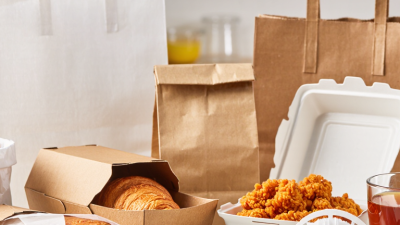
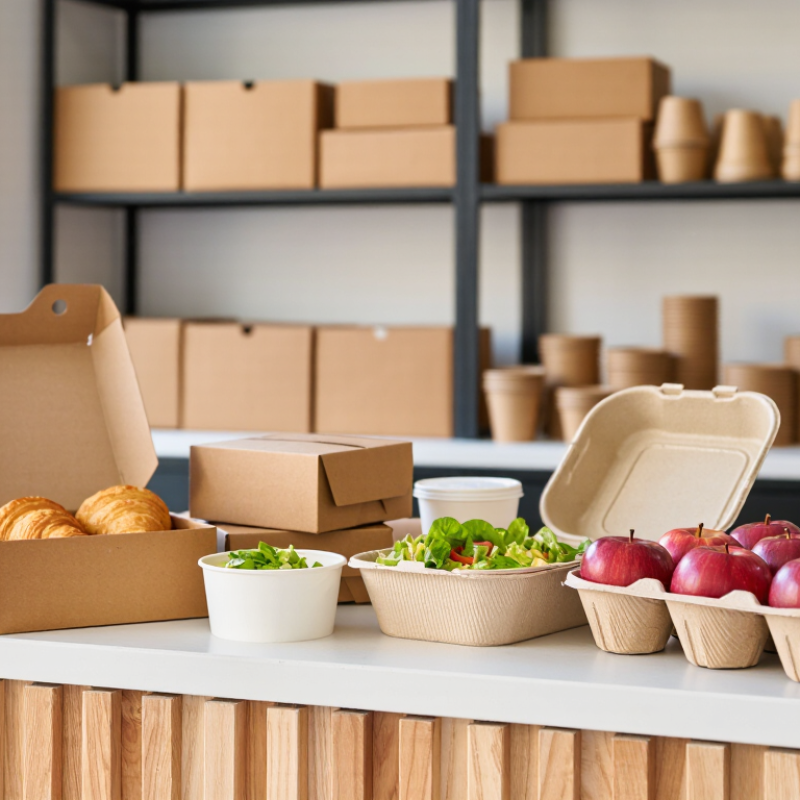
A bakery box that stays dry can protect pastries during a rainy delivery. A molded-fiber tray can cushion fruit without excessive material. Still, paper packaging is not automatically sustainable. This is where honest reflection is necessary. Better results depend on design, infrastructure, and consumer behavior working together. The strongest choice is not always the thinnest package. It is the package that protects food effectively and fits a realistic recovery system.
Paper Packaging Explained: 415 Million Tonnes Produced Globally in 2022 (FAO)
Why Choose Food With Paper Packaging?
Paper packaging is more than a familiar brown box. The Food and Agriculture Organization reported about 415 million tonnes of paper and paperboard production worldwide in 2022. This scale shows paper’s importance in modern food distribution, from bakery cartons to takeaway containers. It also highlights a responsibility: high production volumes require careful material choices and efficient recovery systems.
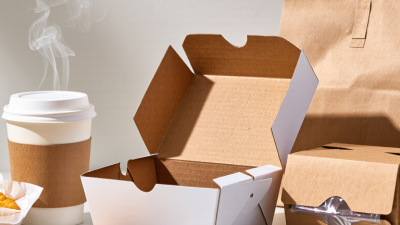
Paper feels light, stores flat, and can protect food during short transport. A folded carton may hold sandwiches, pastries, or dry goods without adding much weight. Its surface also accepts printing clearly, helping staff identify ingredients, dates, and handling instructions. However, ordinary paper cannot safely contain every food. Oil, steam, and liquid can weaken its fibres quickly. Food-contact packaging therefore needs suitable barriers, tested inks, and controlled manufacturing.
The practical details matter. A grease-resistant tray may prevent leaks, while a strong fibre structure reduces crushing in delivery bags. Recyclability can change when paper is heavily coated or contaminated with food. That part is often overlooked. Paper is not automatically the greener choice in every situation; production, transport, reuse, and disposal all affect its impact. In my view, better packaging begins with matching the paper structure to the food, not choosing paper by appearance alone. There is still room to improve.
Food-Contact Safety: FDA 21 CFR 174–178 Governs Paper Components
Why Choose Food With Paper Packaging?
Paper packaging can offer a familiar, lightweight format with strong recycling potential. The U.S. Environmental Protection Agency reported
41.9 million tons of paper and paperboard containers and packaging generated in 2018. About
20.6 million tons were recycled, creating a
49.1% recycling rate.
That figure is encouraging, but recycling performance varies by local systems. Paper is not automatically sustainable.
Food-contact safety requires closer attention. FDA 21 CFR 174–178 governs substances used in food-contact applications. Section 176 addresses paper and paperboard components. Section 175 covers adhesives and coatings, while Sections 177 and 178 address polymers and other indirect additives. Compliance depends on the complete structure, not only the visible paper layer.
Suppliers should provide composition statements, intended-use conditions, and supporting migration data. Temperature, food type, contact time, and recycled content can change risk profiles.
That detail matters.
Tips:
Ask whether the paper, ink, adhesive, coating, and barrier layer comply with the relevant FDA sections. Request test reports for hot, acidic, fatty, or frozen foods. Keep records. Do not treat a general “food-safe” claim as sufficient evidence. In practice, documentation may be incomplete, and some specifications deserve challenge. Smithers’ sustainable-packaging research also identifies regulatory compliance and recyclability as major development priorities. A careful review protects both the food and the credibility of the package.
Paper Packaging Formats and Barriers: Match Fiber, Coatings, and Foods
Why Choose Food With Paper Packaging?
Paper Packaging Formats and Barriers: Match Fiber, Coatings, and Foods
Paper packaging performs best when its structure matches the food’s real demands. A dry biscuit may need stiffness and aroma protection, but little moisture resistance. Paperboard cartons offer smooth printing surfaces and reliable stacking. Corrugated fiber is better suited to shipping heavier cases. Molded fiber can cushion eggs, produce, and takeaway items with less rigid geometry. The format matters.
Uncoated fiber absorbs water and oil quickly. That weakness becomes obvious when soup softens a carton or fried food leaves translucent stains. Water-based coatings can improve moisture resistance, while grease barriers help protect paper from oily foods. Some products also need oxygen or aroma control. A chilled sauce may require a stronger multilayer structure than a bakery box. Thin films or other barrier layers can help, but they may complicate recycling.
Practical testing should use the actual food, temperature, and storage period. Check seal strength, leakage, surface staining, and fiber softening. Food-contact suitability also requires documented material controls for the target market. No format is perfect. A barrier that prevents leakage may reduce easy fiber recovery. I would not promise recyclability from appearance alone. Packaging decisions need evidence from use conditions, not attractive samples on a desk. Sometimes, a simpler paper structure works better.
Circularity at Scale: 82% of European Paper Packaging Recycled in 2022 (CEPI)
Why Choose Food With Paper Packaging?
Circularity at Scale: 82% of European Paper Packaging Recycled in 2022 (CEPI)
Paper packaging can fit naturally into everyday food routines. It feels light, prints clearly, and often uses fewer material types than complex laminated packs. In 2022, 82% of paper packaging in Europe was recycled, according to CEPI. That figure shows established recovery systems working at significant scale. It also reflects years of collection, sorting, and reprocessing expertise.
The result is visible in ordinary places. A clean paper food box can enter a recycling bin, travel to a sorting facility, and return as a fibre-based product. However, recycling is not automatic. Grease, food scraps, plastic coatings, and wet fibres can reduce recovery quality. Local rules also differ. Check them.
From practical handling, dry and empty packaging is easier to recover. Folding a box can save space during collection. Removing loose non-paper parts may help, where local guidance allows it. Still, paper packaging has limits. Some foods need stronger moisture or oxygen barriers, which can complicate recycling. The better question is not whether paper is perfect. It is whether the design supports realistic use, collection, and fibre recovery. Consumers, manufacturers, and recycling operators must share that responsibility. More progress is needed.
Why Choose Food With Paper Packaging? - Circularity at Scale: 82% of European Paper Packaging Recycled in 2022 (CEPI)
| Circularity Dimension |
Verified Figure |
Year / Deadline |
What It Means for Food Packaging |
Source |
| European paper recycling rate |
82% |
2022 |
Paper is supported by a large-scale recycling system across Europe, helping used paper-based packaging re-enter the material cycle. |
Confederation of European Paper Industries (CEPI) |
| EU recycling target for paper and cardboard packaging |
75% minimum |
2025 |
The established EU target sets a clear performance benchmark for the recycling of paper and cardboard packaging. |
European Union Packaging and Packaging Waste Directive |
| EU recycling target for paper and cardboard packaging |
85% minimum |
2030 |
The longer-term target encourages better collection, sorting and recycling performance for paper-based food packaging. |
European Union Packaging and Packaging Waste Directive |
| EU recycling target for all packaging materials |
65% minimum |
2025 |
Paper packaging contributes to the broader European objective of increasing packaging recycling across all material categories. |
European Union Packaging and Packaging Waste Directive |
| EU recycling target for all packaging materials |
70% minimum |
2030 |
The target reinforces the need for packaging formats that can be effectively collected and processed at scale. |
European Union Packaging and Packaging Waste Directive |
| Design consideration for paper food packaging |
Collection-system dependent |
Ongoing |
Recyclability depends on local collection, sorting and recycling infrastructure, as well as the packaging format, coatings, adhesives and food contamination level. |
European recycling and packaging guidance |
Note: The 82% figure refers to Europe's overall paper recycling rate reported for 2022. EU legal targets shown in the table apply to the European Union and use the relevant packaging-waste definitions.
Trade-Offs and Selection: EU Targets 75% Recycling by 2025 and 85% by 2030
Why Choose Food With Paper Packaging?
Paper packaging can offer a familiar, renewable-looking option for food products, but it is not automatically the greener answer. Its value depends on fiber quality, collection systems, coatings, and actual recycling conditions. The EU is targeting 75% recycling for paper and cardboard packaging by 2025, rising to 85% by 2030. These goals increase pressure on manufacturers to design packaging that recycling facilities can process efficiently. However, targets can be affected by national systems and local infrastructure. A package may look simple but perform poorly when grease, moisture, or mixed materials reduce fiber recovery.
Tips: Check whether the pack uses recyclable paper grades. Avoid unnecessary layers. Test it with real food, not only dry samples. Ask suppliers for verified recycling and material data. Small details matter.
In practical packaging trials, moisture resistance often creates the hardest trade-off. A thin barrier can protect food, yet some barriers complicate repulping. More material may improve shelf life, but it can increase weight and waste. Paper also needs careful storage because humidity can weaken folds and seals. That weakness is easy to overlook. Choosing paper packaging should therefore involve performance testing, recycling guidance, and honest end-of-life information. Designers should question whether every coating is necessary, especially when a simpler structure meets food safety and transport needs. The perfect package probably does not exist. Better decisions come from measuring the compromises clearly.
Why Choose Food With Paper Packaging?
Trade-offs and selection: EU recycling targets for paper and cardboard packaging
Potential advantages
Paper and cardboard packaging can enter established recycling streams when it is collected, sorted, and kept reasonably clean and dry.
Key trade-offs
Food residue, moisture, grease, plastic films, and complex barrier coatings may reduce recyclability or require specialized processing.
Selection guidance
Prefer packaging designed for local collection systems, using minimal material and clearly separable components where possible.
Source: European Union Directive (EU) 2018/852. The legally defined recycling targets for paper and cardboard packaging are 75% by 2025 and 85% by 2030. Actual recycling performance can vary by country and collection system.