What Are the Best QR Code Packaging Bags in 2026?
In 2026, a QR code on a package should do more than look modern. It should scan quickly, lead customers to useful information, and remain readable throughout handling and storage. A well-chosen Qr Code Packaging Bag can connect a physical product with recipes, sourcing details, care instructions, or brand support. The best option depends on the product, packaging material, print method, and customer experience—not simply the newest feature.
This guide compares packaging bags by practical criteria: scan reliability, print clarity, durability, material choices, customization, and cost. A glossy pouch may catch the eye, yet glare can make a small code harder to scan under bright shop lights. A matte finish may help, but the final result still depends on contrast, code size, and placement. Test it. Scan samples with several phones, at different distances, before approving a large production run. Check whether folds, seals, or labels could cover the code after packing.
Useful QR experiences also need thoughtful destinations. A fast-loading, mobile-friendly page is usually more helpful than a crowded menu or a link that may soon change. Ask suppliers for material and print specifications, and confirm that samples match the intended product and use. No single bag fits every brand. Even careful testing can miss real-world conditions, so review customer feedback after launch and adjust where needed. These comparisons can help businesses choose confidently while keeping claims about performance grounded in evidence.
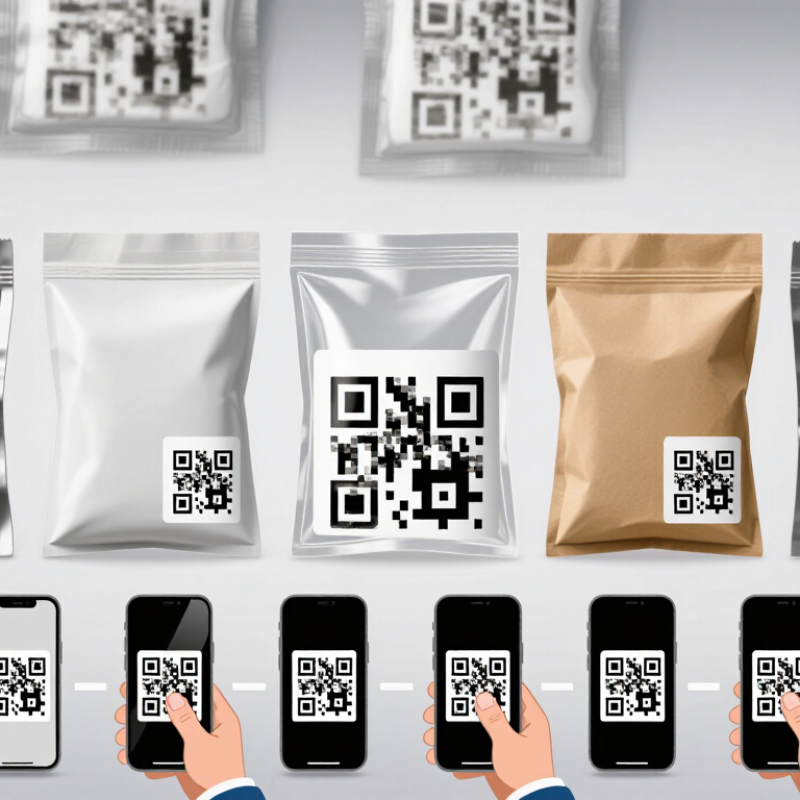
QR Basics for Bags: ISO/IEC 18004 Supports 4,296 Alphanumeric Characters
A QR code on a packaging bag can link customers to ingredients, care instructions, or a product page. ISO/IEC 18004 defines the QR Code symbology and its encoding rules.
Under specific conditions, a symbol can hold up to 4,296 alphanumeric characters. That is a maximum, not a promise for every printed code. Capacity changes with symbol size, error-correction level, and the mix of characters. More error correction can help a code survive minor damage, but it reduces how much information fits.
Keep the code useful, not crowded.
A short web address usually scans more reliably than a dense block of text. On a flexible pouch, folds and curved seams can distort the small squares. Leave a clear margin around the code, use strong contrast, and avoid placing it across a seal.
Small details matter.
Print a sample on the actual bag material, then scan it under ordinary shop lighting with several phones. Test it. A code that works on a flat screen may fail on a crinkled bag. I would not assume one test is enough; packaging shifts during handling, and real-world results can be a little uneven.
Bag Material Choices: Compare PE, PP, and Mono-Material Film Recyclability
What Are the Best QR Code Packaging Bags in 2026?
For a QR-code bag, recyclability starts with the film—not the printed code. PE bags are often a practical choice for flexible packaging, while PP can offer stiffness and a crisp feel. But local collection systems may accept one film type and reject another. Mono-material PE or PP avoids some separation problems found in mixed-material laminates. CEFLEX’s design-for-a-circular-economy guidance stresses compatibility with sorting and recycling processes. A single-material label alone, though, does not guarantee a recyclable bag.
The scale of the challenge matters. The OECD’s Global Plastics Outlook (2022) estimated that just 9% of global plastic waste was recycled in 2019; this figure covers plastic waste broadly, not packaging bags alone. For a QR code, keep inks and coatings limited, and check whether they suit the intended recycling stream. Tiny print can still scan. Test it on a creased, filled bag, not just a flat sample. There is a catch: recycling access varies by market, and material claims need local verification.
Tips: Ask your packaging supplier for the film structure and recycling-design details. Scan-test the code after printing and folding. Don’t assume mono-material means recyclable everywhere.
Retail Readiness: GS1 Targets 2D Barcode Scanning at POS by End-2027
In 2026, the best QR code packaging bags are designed for checkout, not just for a phone camera. GS1’s target is to have retail point-of-sale systems ready to scan 2D barcodes by the end of 2027. That makes the coming year a practical testing window. Bags should carry a clear, scannable code linked to a valid product identifier and useful product information.
A QR code can look polished and still fail at the till. Glossy film, curved seams, folds, and low contrast can confuse scanners. Keep the code away from seals and edges, leave a clear quiet zone, and test it on the finished bag—not only on a flat proof. Where retailers need it, retain a readable linear barcode during the transition. Small details matter.
The code should remain legible after filling, handling, and transport. Test samples under store lighting and with different scanning angles. Check that linked information loads quickly and stays accurate when packaging details change. No design works everywhere. A bag that scans reliably on a desk may crease in a shopper’s hand, and that is easy to overlook. Retail readiness means checking both the digital destination and the printed mark before production scales.
Print Quality Testing: ISO/IEC 15415 Grades 2D Symbols from 0 to 4
For QR code packaging bags, print quality is more than visual sharpness. ISO/IEC 15415 evaluates 2D symbols and assigns numeric grades from 0.0 to 4.0; higher grades indicate stronger measured quality. The result depends on defined test conditions, including aperture and illumination. A calibrated verifier, not a phone camera, checks factors such as contrast, modulation, and cell geometry. Small marks matter.
On flexible bags, glossy film, curved seals, wrinkles, and ink spread can weaken a code after printing. Test samples from several positions and production runs, then scan with a phone as a practical check, not as the grading method. Record verifier settings with each result; grades from different setups may not be directly comparable. A 4.0 is not a promise that every shopper’s camera will read every bag. Honestly, one test can miss a bad batch. Ask for grade reports on the finished bag, not just a flat artwork proof.
What Are the Best QR Code Packaging Bags in 2026?
Use the ISO/IEC 15415 2D-symbol print-quality scale to assess QR code print quality on packaging.
How to read it: ISO/IEC 15415 assigns 2D symbols a numeric print-quality grade from 0 to 4; higher grades indicate better symbol quality. The bars show the scale, not test results for specific bags. Compare packaging samples using a calibrated verifier under consistent conditions.
2026 Selection Framework: Rank QR Bags by Scanability, Traceability, and Cost
The best QR code packaging bags in 2026 are the ones that scan reliably, carry useful traceability data, and fit the real production budget. Start with scanability. Test printed samples on filled bags, not just flat proofs. Check scans under warehouse lighting, after handling, and where the film wrinkles near a seal. A code that works only on a clean desk is not production-ready. Keep enough contrast and quiet space around the code, and avoid placing it across folds.
Next, rank traceability by how easily each scan connects a package to a production lot, packing date, or product information page. Use a stable identifier and confirm that the destination stays accurate when records change. Test with several common phone cameras. Small details matter. A fast scan is useless if it opens an outdated page or cannot identify the batch.
Finally, compare total cost per usable bag, including variable-code printing, setup, inspection, and rejected packs. A low quoted price may hide costly reprints. Score each option from one to five for scanability, traceability, and cost, then weight the scores according to your operation. For most teams, scanability should be a minimum pass, not a feature to trade away for savings. Still, testing every line condition can be awkward, and a small sample may miss problems that appear during a long run. Keep a few production samples for repeat checks.
What Are the Best QR Code Packaging Bags in 2026?
2026 Selection Framework: Rank QR bags by scanability, traceability, and cost.
Indicative comparison of common packaging formats—not a laboratory test or a survey of specific products. | Rank | Packaging Bag Type | Scanability
(1–5) | Traceability Readiness
(1–5) | Cost Advantage
(1–5) | Weighted Score | QR Code Considerations | Best Suited For |
| 1 | Matte laminated stand-up pouch | 5 | 5 | 3 | 4.4 / 5 | Matte surfaces generally reduce glare. Reserve a flat, uncreased print area and verify contrast and code size on the finished pouch. | Products needing a prominent consumer QR code and optional batch or serialized printing. |
| 2 | Kraft paper pouch with barrier liner | 4 | 4 | 4 | 4.0 / 5 | Paper can provide a low-glare print surface, but texture, coatings, and print contrast should be checked on production samples. | Dry goods and products where a paper-forward appearance and clear printed information are priorities. |
| 3 (tie) | Mono-material PE stand-up pouch | 4 | 4 | 3 | 3.8 / 5 | Flexible film can wrinkle or distort a code. Place the code on a stable panel; recyclability depends on local collection and sorting systems. | Brands seeking a flexible-film format designed around a single polymer material structure. |
| 3 (tie) | Clear PE bag | 3 | 4 | 5 | 3.8 / 5 | Contents behind the code can reduce contrast. Use an opaque print panel or label, and test the code with the actual contents inside. | Cost-sensitive applications where product visibility is important and a contrasting code area can be added. |
| 5 | Glossy laminated stand-up pouch | 3 | 4 | 3 | 3.3 / 5 | Reflections may interfere with scanning under some lighting. Avoid placing the code across seams, folds, or curved areas. | Products that need a glossy finish and can accommodate scan testing under typical retail and home lighting. |
| 6 | Small flat sachet | 2 | 3 | 5 | 3.0 / 5 | Limited printable space can constrain code size and surrounding clear space. Confirm legibility at the final printed dimensions. | Single-use or sample formats where the code can link to a concise mobile-friendly destination. |
| Scoring method: Indicative 1–5 ratings; higher cost-advantage scores mean lower relative packaging cost. Weighted score = scanability 45% + traceability readiness 35% + cost advantage 20%. Traceability depends on the QR destination and data system: a printed code alone does not provide unique item-level tracking. Test finished production samples for scanning before launch. |